- info@wildlife-removal.com
Call us for help in your town
Wildlife Removal Education
Raccoon Removal and Control
Need raccoon removal in your hometown? We service over 500 USA locations! Click here to hire us in your town and check prices - updated for year 2021.
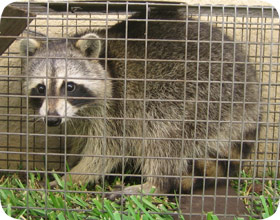 Raccoons are usually classified as a pest species due to their habits of living in human dwellings. The most common complaints include the following:
- Raccoons living in the attic
- Raccoons living in the chimney
- Tipping over garbage cans
- Stealing pet food or bird seed
- Sick, potentially rabid raccoon
- Presence is alarming dogs/pets
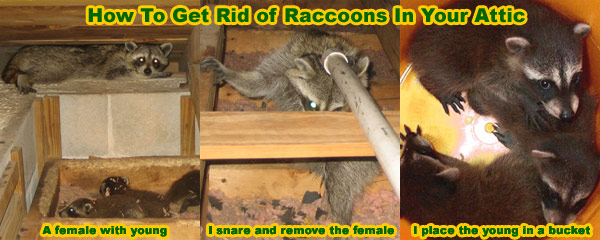
Since it's a very common problem, I have here an advice article with photos on how to get raccoons out of the attic. Please read this guide - a raccoon in
your attic or house is almost certainly a female with a litter of young. The job is often complex, and the worst thing you can do is simply set down a cage trap on the ground.
NUISANCE CONCERNS:
Raccoons are one of the most commonly dealt with nuisance animals. They have adapted to living with humans.
They have learned that garbage cans and dumpsters are excellent sources of food, and that houses are excellent habitat. A mother
raccoon will often tear a hole in a roof to access an attic, where they will make quite a mess and a lot of noise. If you have a
raccoon in the attic, it's going to make a big mess and leave a lot of droppings. Click here for photos of raccoon poop. They are strong animals, and once
inside an attic, they often tear off insulation paper, rip open ducts, tear insulation off pipes, etc. Here are some photos of: raccoon damage inside an attic.
They will search hard for food, and are fond of tipping over trash cans, raiding dumpsters,
and stealing pet food. They will often break into a screened-in porch to get pet food. It's common for raccoons to poop in a swimming pool. They carry a number of parasites and
diseases that can affect people or pets.
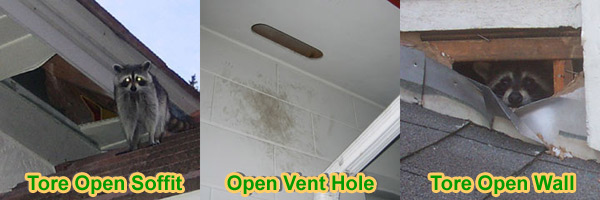
RACCOON BIOLOGY: (Procyon lotor) Raccoons are easy to recognize with their distinctive black mask and ringed tail. Adults range from 10 lbs on up, with some reaching over 40lbs. They can live up to
12 years in the wild, though average life spans average closer to 5-6 years. Raccoons mate in the winter, around December, and the females give birth to an average of 3-5 young. A mother raccoon is very protective
of its litter of 3-5 young, usually born in the spring time. Like many mammals, they are primarily nocturnal, though some people spot them during the day, often when
in search of food. They are omnivores, and will eat almost anything they can get those crafty hands on.
RACCOON BEHAVIOR: They are very common animals, particularly in urban areas. They are well adapted for survival in cities. They are excellent climbers, and they have
very nimble hands. They are also strong, and they often explore, tearing new areas open in search of food and shelter. They like to den in trees, but they love to den in attics.
 RACCOON DISEASES:
They are a common carrier of rabies, a potentially fatal disease. They also carry canine distemper, which can kill your dog. Their feces may contain raccoon roundworm, the spores of which humans can breath in and
become seriously infected by, so it is important to capture raccoons using human habitat. Click the image to the left to visit Rabies Control Website for more
information on this disease.
RACCOON DISEASES:
They are a common carrier of rabies, a potentially fatal disease. They also carry canine distemper, which can kill your dog. Their feces may contain raccoon roundworm, the spores of which humans can breath in and
become seriously infected by, so it is important to capture raccoons using human habitat. Click the image to the left to visit Rabies Control Website for more
information on this disease.
HOW DO I GET RID OF RACCOONS?
The only real means of getting rid of raccoons is through trapping and removal of the animals, and exclusion repairs to keep them out in the future. If you've got raccoons in your attic, it's important that the wildlife operator search for a litter of baby raccoons, and
remove them by hand before trapping and removing the female raccoon. If it's just raccoons outside causing trouble, they can be trapped and removed, but beware, they'll often dig and grab anything within a few inches of
the cage trap. There are also some lethal raccoon traps, but they're not often used or even legal in all states. Here is some information about how to trap a raccoon and some more
information including raccoon trapping tips.
I also have some additional information and photos about how to get rid of raccoons in the attic and house, yard, tree, roof, which is often a very difficult and complex wildlife control procedure.
CAN'T I JUST USE A REPELLENT?
There is no registered or effective raccoon repellent available. Here is a raccoon repellent analysis that I wrote. You can find some products on the market, such as mothball-based or urine-based repellents, but they are bogus. Go ahead and try them. And those high-pitch
noisemakers, also called ultrasonic sound emitters, do not work. There is no quick and easy fix when it comes to raccoon removal and control. It's best to have a professional trap and remove the animals properly.
Phoenix Raccoon Control -
Los Angeles Raccoon Control -
San Diego Raccoon Control -
San Jose Raccoon Control -
Denver Raccoon Control -
Orlando Raccoon Control -
Miami Raccoon Control -
Jacksonville Raccoon Control -
Atlanta Raccoon Control -
Chicago Raccoon Control -
Baltimore Raccoon Control -
Boston Raccoon Control -
Minneapolis Raccoon Control -
Charlotte Raccoon Control -
Portland Raccoon Control -
Philadelphia Raccoon Control -
Houston Raccoon Control -
Seattle Raccoon Control
HOW TO KEEP RACCOONS AWAY FROM PROPERTY?
It's hard to keep raccoons from accessing your property. It would take a special fence to prevent them from climbing it - they are amazing climbers. And there are no machines or devices that can keep them away - products such as flashing
lights, sound machines, and water sprinklers have demonstrated no effectiveness. I've already discussed the ineffectiveness of repellents such as sprays or powders. The truth here is that raccoons on your property or in your yard are
not really a problem. The problem is that they are interacting with some part of your property that you don't want, right? Like, they're getting into your garbage, or eating your birdseed, or living under your shed or porch, or
tearing up your new sod, or pooping in your pool, or eating your crops, or killing your decorative goldfish, or threating your cat, and so on. That's the key - something about your property is
attracting the raccoons! The best way to keep them away is by eliminating
the attractive source, or by making it inaccessible. If they are getting into your house, seal shut the entry holes! If they are eating your pet's food, bring the pet food indoors. Read more
tips for how to keep raccoons away here or where to release a trapped raccoon.
Raccoon Email From Reader: Morning sir, I have & have had a raccoon in the ceiling for about three years now. I don't own the house thank GOD, I rent here. I've discussed this issue
with the owner of the property on numerous occasions. I've seen the raccoon just as I've seen the squirrels & possums that roam the area (not sure which is up there). They have disturbed
the chimney brick of the next house as well. I can hear them moving it. Honestly, I'm afraid. I can move but I'd prefer NOT too @ the moment if I can help it (time & job constraints). Finally,
the landlord wants to send out two carpenters today or this weekend to open the ceiling & place a trap (soft & unsure I decline). They intend to re-seal the ceiling with piece of plywood screwed
in. I don't know about this method. They've had NO success with this same trap that they laid on the roof (so they say). What do u think? I'm positive that they know nothing about what they are
doing. This is my health @ stake. Any advice or help on the subject will so be appreciated. I've called & left a message with the gentleman u had listed for Philadelphia are. Please help! :( ~ Herb ~
My Response: DO NOT HAVE THE CARPENTERS DO IT. They are no more qualified to do dentistry. Seriously. There's a lot of complex issues with raccoons in the ceiling, and the carpenter, who
has no experience in dealing with them, will likely make things worse. They probably won't trap anything, but the raccoon may break into the house if it has no other way out, and if it is
improperly removed, what about the baby raccoons that are likely up there? You need a wildlife pro, and Kris in Philadelphia is very good. Try to hire him.
Other raccoon articles I've written:
raccoon bait - Advice on what bait to use to catch a raccoon.
raccoon in chimney - If you've got one in your chimney or
fireplace.
raccoon pest control - Traditional pest control methods are ineffective.
raccoon in the house - If the animal is anywhere inside your house.
how to kill a raccoon - Alternatives to poisoning or killing raccoons.
Raccoon Prevention Tips - In addition to the repellent advice.
What Attracts Raccoons? - What to eliminate on your property to keep them from coming.
Select Your Animal

RaccoonsRaccoon Removal Information & How-To Tips

SquirrelsSquirrel Removal Information & How-To Tips

OpossumOpossum Removal Information & How-To Tips

SkunksSkunk Removal Information & How-To Tips

RatsRat Removal Information & How-To Tips

MiceMouse Removal Information & How-To Tips

MolesMole Removal Information & How-To Tips

GroundhogGroundhog Removal Information & How-To Tips

ArmadillosArmadillo Removal Information & How-To Tips

BeaverBeaver Removal Information & How-To Tips

FoxFox Removal Information & How-To Tips

CoyotesCoyote Removal Information & How-To Tips

BirdsBird Removal Information & How-To Tips

BatsBat Removal Information & How-To Tips

SnakesSnake Removal Information & How-To Tips

DeadDead Animal Removal Information & How-To Tips

OthersOther Wildlife Species Information & How-To Tips